

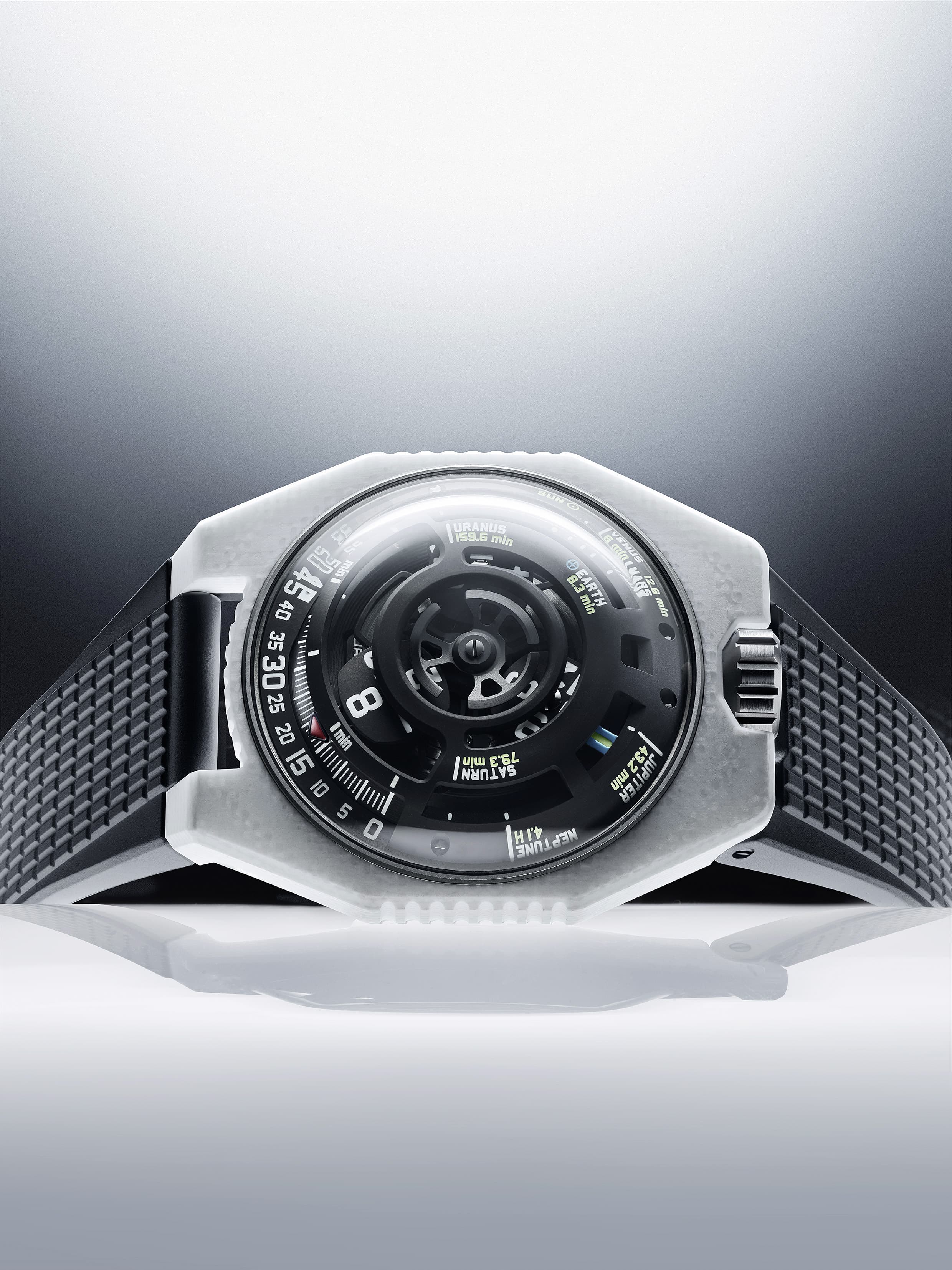
Some watchmakers speak to the heart of what time means to the editorial team here and Urwerk shot to the top of a very short list with the UR-100V LightSpeed in 2024. As the editor frequently bemoans, space limitations meant we could not get to the watch then. Happily, Urwerk gives us a second chance with the UR-100V LightSpeed Ceramic this year; the watch is so fresh that it was not yet listed on The Hour Glass website as of writing. Anyway, Urwerk co-founders Felix Baumgartner and Martin Frei have spent decades questioning what time actually is and presenting their unique spin on it. Urwerk’s latest creation, the UR-100V ‘LightSpeed’ Ceramic, like the original LightSpeed, concerns itself with measuring the time it takes for a photon to travel from the Sun to the edges of our solar system.
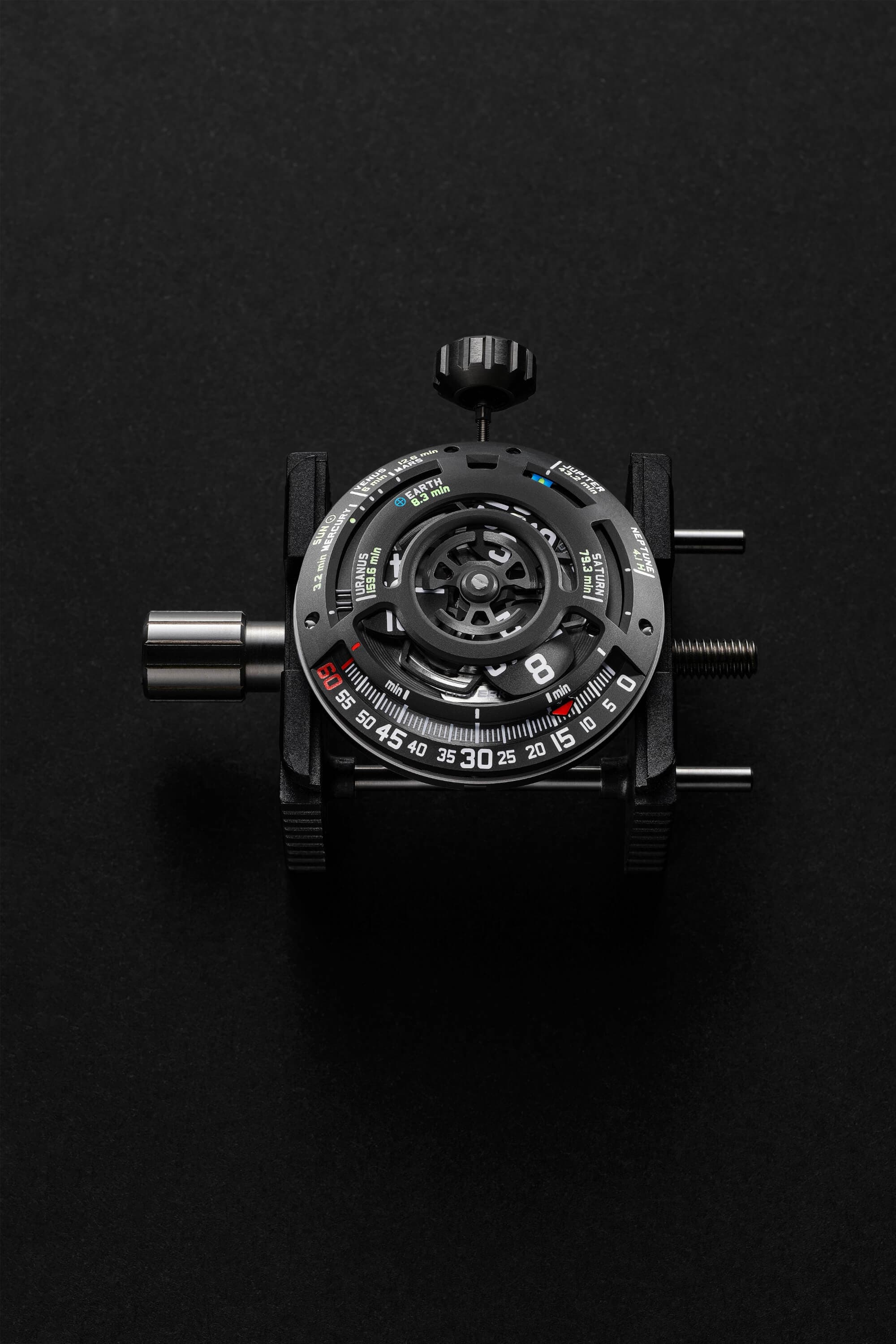
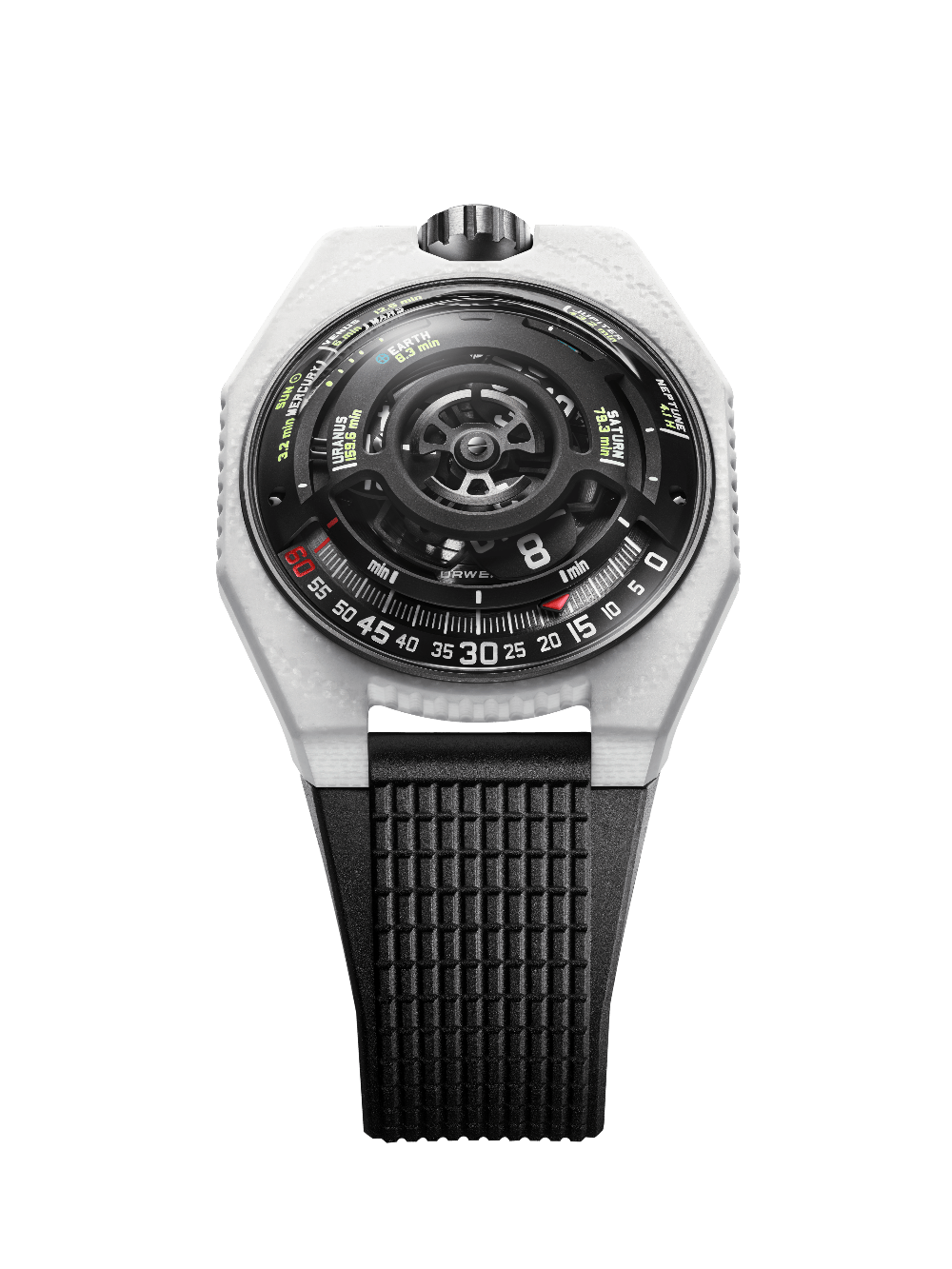
The UR-100V platform has always been about more than just the “wandering hour” satellite indication that made the brand famous. In this new LightSpeed iteration, the watch becomes a mechanical translation of astronomy. Once the hour satellite completes its 60-minute journey across the lower arc of the dial, it does not just disappear. Instead, it passes under a sapphire canopy to reveal a different kind of measurement.
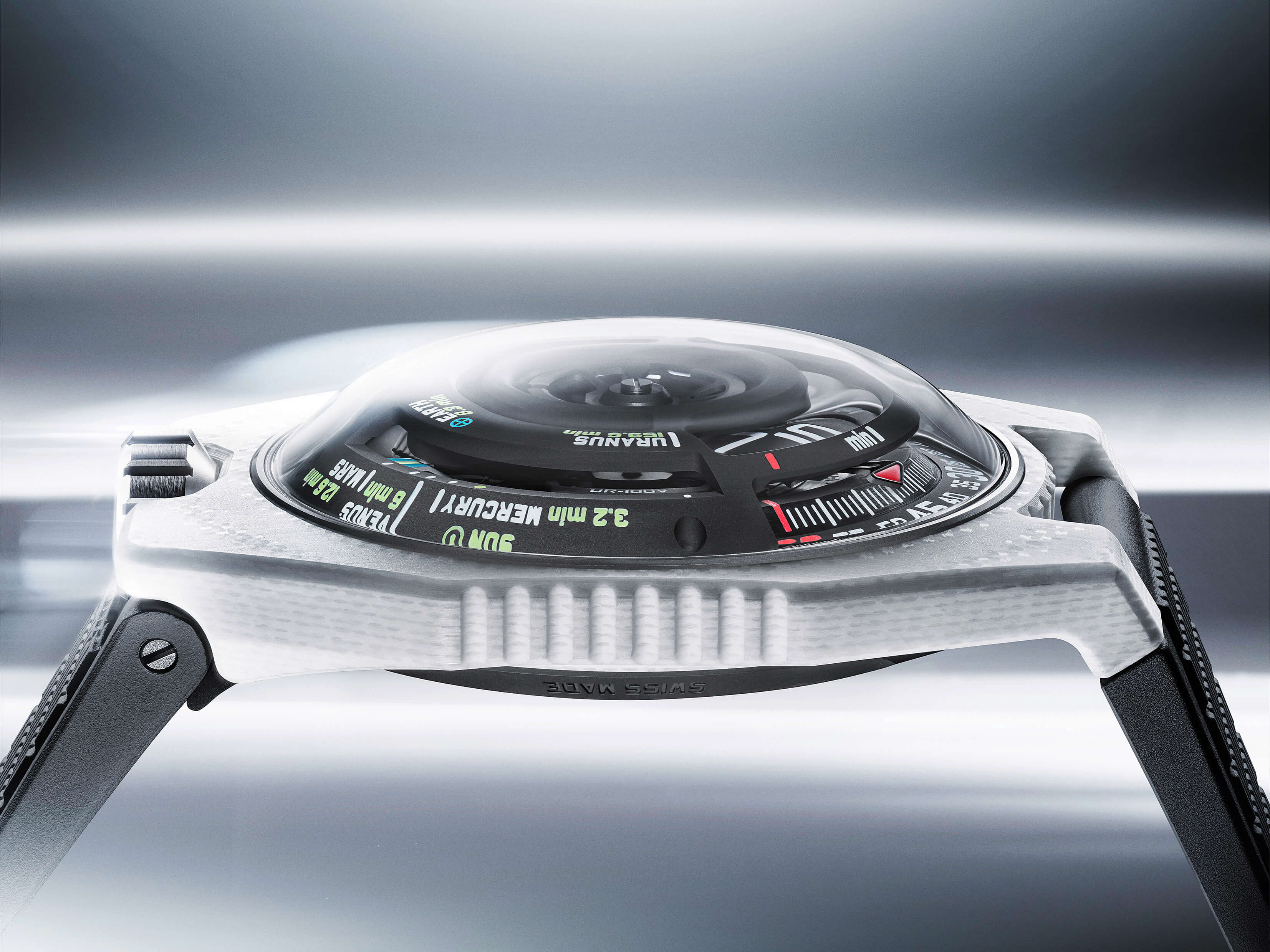
As the satellite traverses the upper part of the dial, it tracks the distance light travels across the vacuum of space. The dial provides a sequence of eight scientific data points: sunlight reaches Mercury in 3.2 minutes, Venus in 6.3 minutes, Earth in 8.3 minutes, and so on up till Neptune in 4.1 hours. It is a sobering reminder that what we perceive as the “present” is actually a collection of memories delivered by light. The editor discovered the watch, to his delight, in person when it originally debuted, and reports that the effect here is transcendental – if you are the sort of person who muses on cosmic phenomena and astrophysics.
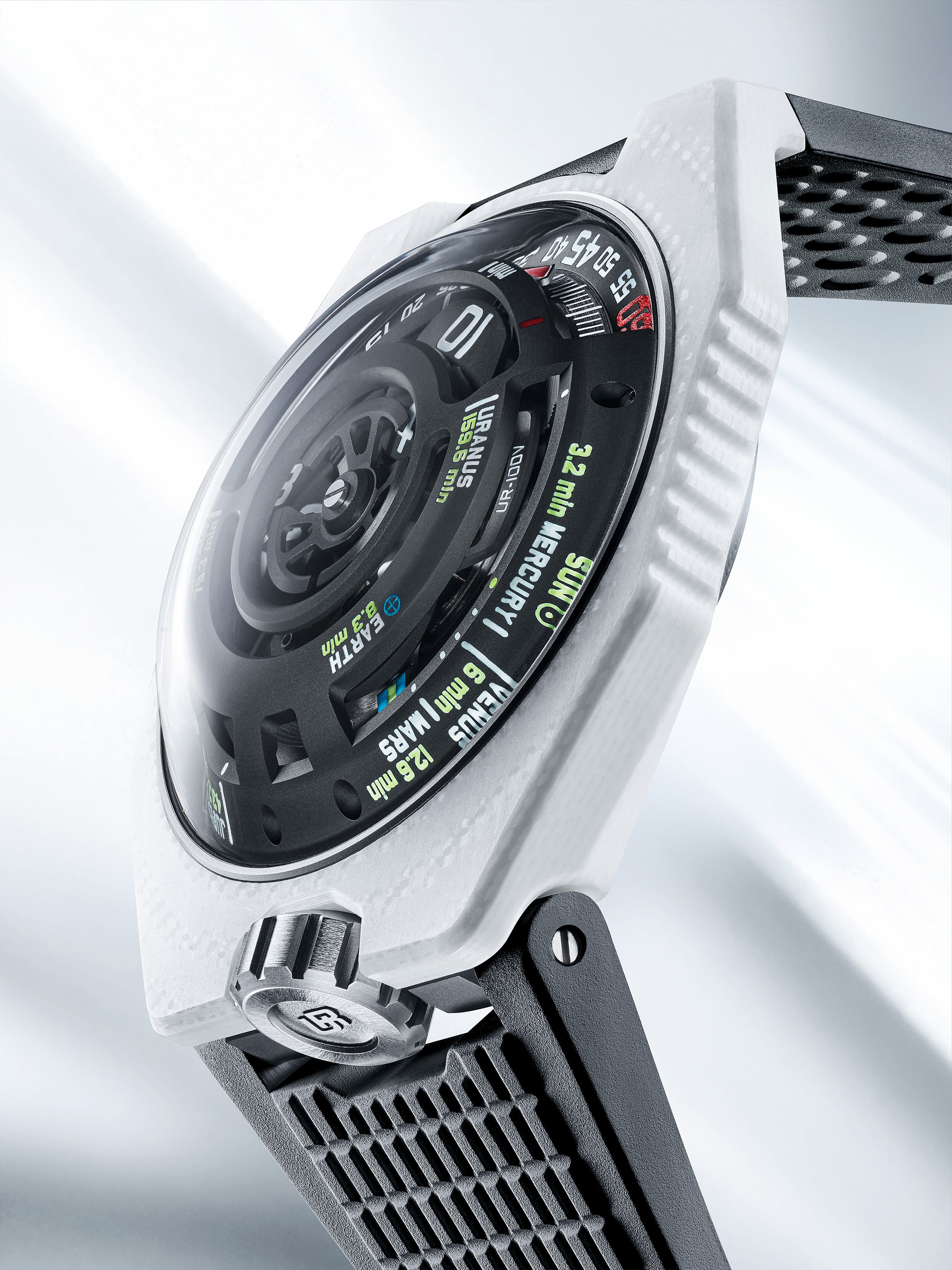
The most striking visual update now is the stark, clinical white case. However, in true Urwerk fashion, this is not just standard ceramic. Traditional ceramics are notoriously hard but brittle, prone to shattering upon impact (as we and other specialists have repeatedly warned). To solve this, Urwerk developed a proprietary composite – a polymer matrix integrating finely woven ceramic fibres alternating with layers of glass and carbon fibre.
The resulting material is engineered for resilience, utilising technologies derived from aeronautics. Aesthetically, Frei describes the white finish not as a colour, but as an “optical effect” that reflects and scatters incoming light, creating a subtle visual depth that oscillates between deep matte and soft luminescence.
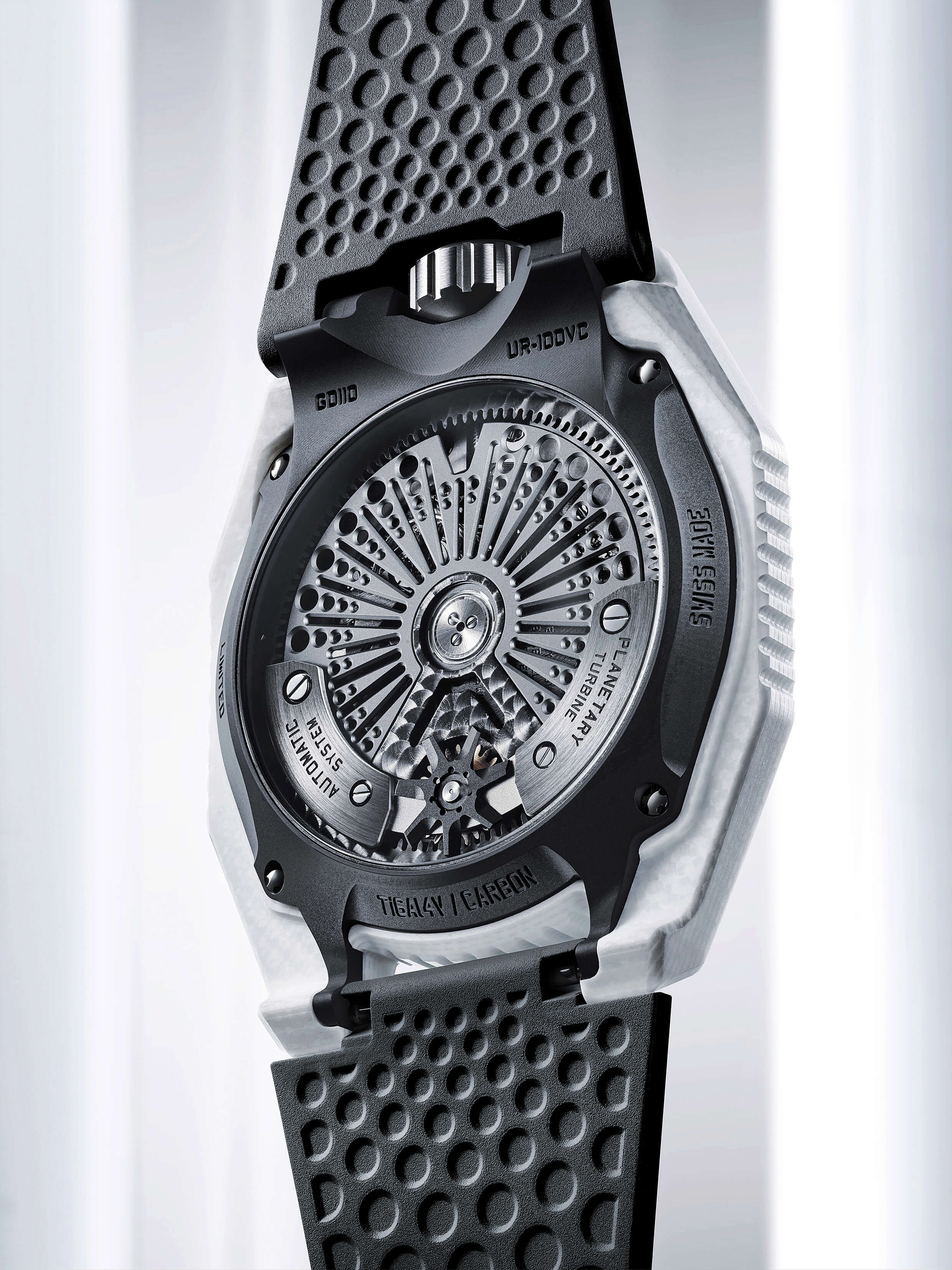
Beneath the three-dimensional planetary display beats the UR 12.02 automatic calibre. The movement features a kinematic structure distributed across three ARCAP alloy plates, chosen for their long-term stability. The winding efficiency is governed by the “Windfänger” system – an air-resistance turbine that prevents the rotor from over-winding or experiencing excessive wear during high-activity mo
Read more from original article, all rights reserved UR-100V LightSpeed Ceramic and the Mechanics of Cosmic Time
Leave a Reply